// Permutations
// Option 1, fix prefix, add a letter to the end of current space.

Source code:
function get_suffix(surffix, charIdx) {
var arr = surffix.split("");
arr.splice(charIdx, 1);
var newSurffix = arr.join("");
return newSurffix;
}
function permSuffix (str) {
var myArr = [];
var permNext = function f_permNext(prefix, surffix, initStr) {
//call example: permNext("","abc","abc");
var newPrefix = "",
newSurffix = "";
var strLen = initStr.length;
var i = 0;
console.log("start func: " + prefix, i, surffix);
if (prefix.length === strLen) {
myArr.push(prefix);
console.log("** Combined: " + prefix);
return;
}
for (i = 0; i < surffix.length; i++) {
newPrefix = prefix + surffix[i];
newSurffix = get_suffix(surffix, i);
console.log(newPrefix, i, newSurffix);
f_permNext(newPrefix, newSurffix, initStr);
}
};
permNext("", str, str);
return myArr.length;
}
permSuffix("123");
> 6
// options 2, Introduce and insert a letter to the space of prefix.
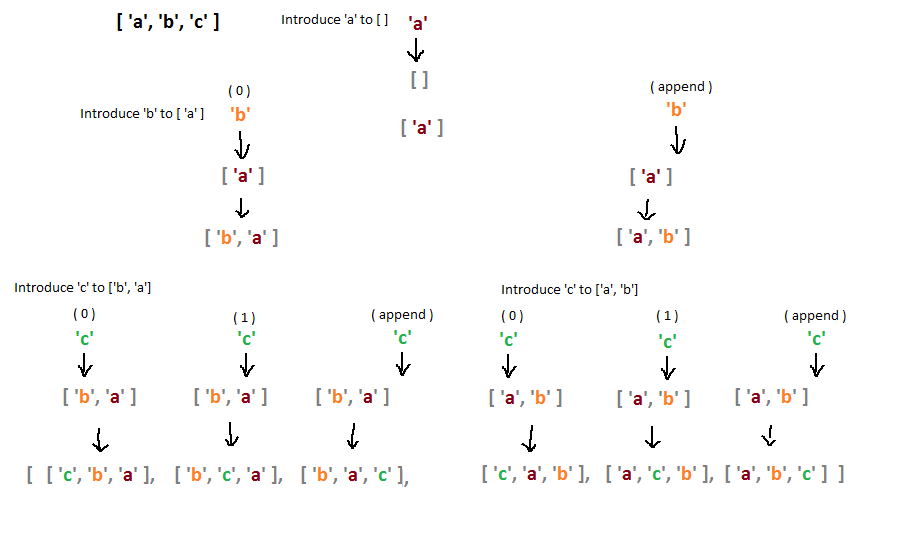
Source code:
function introChar(targetStr, chr) {
var arr = [];
var strArr = [];
for (var i=0; i<=targetStr.length; i++) {
strArr = targetStr.split("");
strArr.splice(i, 0, chr);
arr.push(strArr.join(""));
}
return arr;
}
introChar("abc", "1");
function permInsert (str) {
var myArr = [];
var permIntro = function f_intro (arr, pos, permStr) {
console.log(pos, arr, permStr);
var len = permStr.length;
if (pos >= len) {
myArr = myArr.concat(arr);
console.log(arr);
return;
}
if (arr.length === 0) {
arr = introChar("", permStr[0]);
pos++;
}
chr = permStr[pos];
pos++;
arr.forEach( function(val) {
var plusCharArr = introChar(val, chr);
console.log(plusCharArr);
f_intro(plusCharArr, pos, permStr);
});
};
permIntro([], 0, str);
return myArr.length;
}
permInsert("abcde");
> 120
// Reference, arr is reference type, the paramenter is a link,
// update in a function, update outside arr elements value too.
var yiArr = [7,8,9];
function cut1 (pArr) {
lArr = pArr.slice();
lArr.splice(1, 1);
return lArr;
}
cut1(yiArr);
yiArr;
